Living Room Wall Decor Ideas: Above-Couch Floating Shelves That Won’t Fall on Your Head
- Blog Living Room
 Alina
Alina- 0
- 20 minutes read


Living Room Wall Decor Ideas
Floating shelves above the couch are one of the best-looking ways to fill that big blank wall, until you remember they’re hanging directly over where people’s heads go. And here’s the uncomfortable truth most decor posts skip: a floating shelf loaded with heavy pottery, mounted into nothing but drywall, is a genuine hazard waiting for a door slam or a curious kid to bring it down. The good news is that a shelf done right is rock-solid and gorgeous, and it comes down to two things: hang it into something structural, and style it so it looks designed rather than dumped.
So this is both a safety guide and a styling guide, because above a sofa you need both. Get the mounting right first (that’s non-negotiable when it’s over someone’s head), then have fun with what goes on top. Here’s everything, from studs to styling.
First, the safety reality: this shelf is over people’s heads
Before a single decor idea, understand the stakes. A floating shelf above a couch sits right over where you and your guests sit, so if it fails, it doesn’t just break your stuff, it lands on someone. That raises the bar from “looks nice” to “must be genuinely secure,” and it’s exactly why the mounting matters more here than almost anywhere else in the home.
The people who install these for a living are blunt about it: above a couch, you want zero doubt about what’s holding the shelf up. Treat the installation as the real project and the styling as the reward, not the other way around.
The golden rule: mount into studs, not just drywall
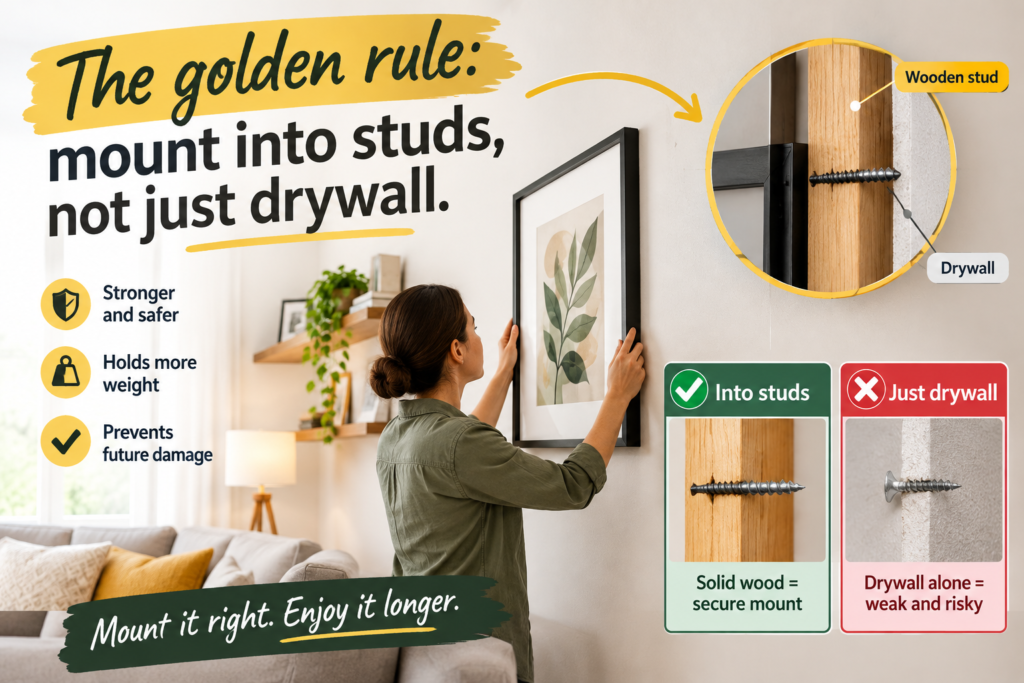
Here’s the single most important fact in this whole article: floating shelves must be anchored into the wall studs, the vertical wooden beams behind your drywall, not into drywall alone. A screw in drywall pulls out under load; a screw in a stud transfers the weight into the actual structure of your house.
The numbers make it vivid. A floating shelf holds roughly 45 to 50 pounds per stud it’s bolted to, so a shelf hitting two studs safely carries around 90 to 100 pounds. Mounted into drywall with anchors only? You’re looking at maybe 10 to 25 pounds before it’s at risk, and reputable installers simply don’t recommend drywall-only above a couch. Studs are the whole ballgame.
How to actually find your studs
Finding studs isn’t hard. The easiest way is a stud finder, cheap at any hardware store and worth every penny. No stud finder? Use the knock test: tap along the wall and listen for the sound to go from hollow to solid. Studs are also reliably found beside light switches and outlets (which are mounted to them), and on either side of windows.
Studs are usually spaced 16 inches apart (sometimes up to 24 inches in older homes), so once you find one, measure over to locate the next. Mark them lightly in pencil before you drill. This five-minute step is what separates a shelf that lasts for years from one that ends up on the cushions.
If you genuinely can’t hit a stud
Sometimes the spot you want just doesn’t have a stud where you need it. If that happens, don’t fall back on cheap plastic anchors, use serious hardware: heavy-duty toggle bolts or molly bolts, which expand behind the drywall to grip a much wider area and mimic some of a stud’s holding power.
Even then, keep the load genuinely light, decorative-only, and understand it will never be as strong as a stud. The gold-standard fix if you’re serious is to add blocking (horizontal wood between the studs behind the wall), but that’s a job for when the wall’s open or for a pro. When in doubt above a couch, move the shelf a few inches to hit a real stud.
Choose a solid shelf, not a hollow box
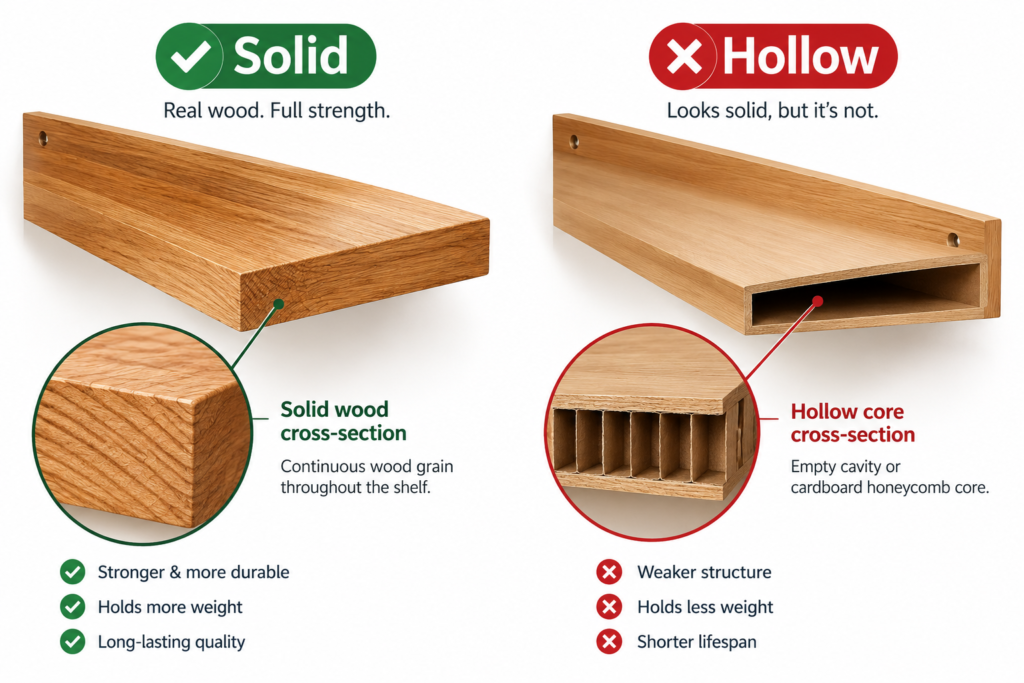
The shelf itself matters as much as the mount. Solid wood or metal shelves are strongest; cheap MDF, particleboard, and hollow “box” shelves (miter-folded plywood that looks chunky but is empty inside) are far weaker and can sag or fail under real weight. The bracket and a flimsy shelf are a bad combination over a sofa.
Look for a shelf with a proper heavy-duty bracket, ideally one whose support rods run at least half the shelf’s depth, and solid construction throughout. Spending a bit more on a genuinely sturdy shelf is cheap insurance when the thing hangs over your head.
Stress-test before you trust it
This is the step almost everyone skips, and it’s your final safety check. Once the shelf is mounted but before you load it with anything you care about (or anyone sits beneath it), press down firmly on it with your hands, lean some real weight into it. If you feel any give, movement, or flex, stop. That wobble is the shelf telling you the mount isn’t solid enough.
A secure shelf feels immovable. If it doesn’t, re-check that you’ve hit studs, add another anchor point, or reposition. Better to find the weakness with your palm now than with a crash later. Then load it gradually, a few items at a time, rather than all at once.
Match what you display to what the mount can hold
Safety and styling meet right here: decide what the shelf will hold, then mount accordingly, and never overload it. For an above-couch shelf that’s decorative, keep to genuinely lightweight items, framed prints, a couple of small plants, light ceramics, a few paperbacks. Save the heavy stacks of hardcovers, big stoneware, and dense objects for shelves you’ve mounted into two or more studs and stress-tested.
The rule of thumb the pros use: underestimate the load rather than overestimate it. When it’s over a sofa, err firmly on the side of lighter. A shelf that could hold 90 pounds is safe holding 15; the reverse is how accidents happen.
Watch for sagging, your early warning sign
Even a well-hung shelf can develop trouble over time, and sagging is the red flag. A shelf that starts to droop or pull away from the wall is struggling with its load and is one door slam away from coming down. Don’t ignore it.
If you spot sag, take everything off, re-mount properly into studs (or add support), and lighten the load before putting things back. Catching a sag early is how you prevent the dramatic failure later. Give your above-couch shelf a glance now and then to make sure it’s still sitting tight and level.
Now the fun part: how high to hang it
With safety sorted, let’s make it look good, starting with placement. Just like art above a sofa, a floating shelf should relate to the couch, not float way up near the ceiling. Hang it so the shelf sits roughly 8 to 12 inches above the top of the sofa back, close enough to feel connected to the furniture below.
Too high and it looks disconnected and marooned; too low and you’ll knock your head or the items when you sit. That 8-to-12-inch zone keeps it visually anchored to the sofa and safely clear of leaning-back heads. If you’re stacking two shelves, keep even spacing between them.
Size it to the sofa, around two-thirds the width
Proportion is what makes it look intentional. Aim for your shelf (or the total span of a pair) to be about two-thirds to three-quarters the width of the sofa. A little shelf stranded over a wide couch looks lost; a well-scaled one anchors the whole wall.
For a standard sofa, that usually means a shelf in the 3-to-5-foot range, which also conveniently spans two or more studs, giving you both the right look and a stronger mount. Proportion and safety happen to point the same direction here.
Style in odd numbers and vary the heights
Now for what goes on top. The reliable styling formula: arrange objects in groups of three (odd numbers just look more balanced than even), and vary the heights within each group, something tall like a vase or a leaning frame, something medium, something low. That rise and fall is what reads as “styled” rather than “lined up.”
Avoid the trap of spacing everything evenly at the same height like a row of soldiers, it looks flat and accidental. Cluster, vary, and let the arrangement breathe. This single principle does most of the work in making a shelf look designer.
Layer art at the back, objects in front
Depth is the secret ingredient. Instead of standing everything in a single row, lean framed art or prints against the wall at the back of the shelf, then place smaller objects, a little plant, a candle, a small sculpture, in front of them, slightly overlapping. That front-to-back layering gives the display richness and that collected, gathered-over-time look.
Leaning art also means fewer holes in the wall and an easy way to swap things seasonally. On an above-couch shelf, this layered look is what elevates it from a storage ledge to a piece of decor.
Leave breathing room, don’t cram it
The most common styling mistake is overfilling. A shelf packed edge to edge reads as cluttered (and, bonus, is heavier and more stressed). Leave deliberate empty space between your groupings so each piece can be seen. Negative space is what makes the objects you do display feel chosen and intentional.
A good test: style the shelf, then remove a couple of things. It almost always looks better with room to breathe. Restraint reads as expensive; clutter reads as chaos, and on a floating shelf, less is genuinely more in both looks and load.
Repeat colors and materials for a pulled-together look
To make the whole display feel cohesive rather than random, thread a consistent palette or material through it. Stick to two or three colors, or echo a material like warm wood, brass, or matte ceramic across a few pieces. Repetition is what ties a collection of different objects into one intentional-looking vignette.
Pull one of those colors from elsewhere in your living room, a cushion, the rug, the art, and the shelf instantly feels connected to the whole space rather than stuck on as an afterthought.
Add greenery to keep it from feeling static
A small touch of green brings a shelf to life. A little trailing plant (pothos is forgiving), a sprig in a bud vase, or even a nice faux stem softens the hard lines and adds freshness that an all-frames-and-ceramics shelf lacks, just keep it light for the reasons above.
Trailing greenery spilling gently off the edge of a shelf is one of the most-loved above-couch looks, and it photographs beautifully. It’s the finishing layer that makes the whole thing feel warm and lived-in.
Try mixed media instead of all matching frames
For a more collected, designer feel, mix your media rather than hanging a set of identical frames. Combine a framed print with a small mirror, a woven or textural piece, a piece of pottery, a stack of books. That variety of shape, texture, and finish creates the layered, intentional look designers favor.
An all-matching set can feel a bit flat and showroom-y; a considered mix feels like you. Just keep the palette disciplined so “mixed” reads as curated, not chaotic.
Consider two staggered shelves for more impact
If one shelf feels sparse on a big wall, two shelves staggered or stacked can fill the space beautifully and give you more to style, just double down on the safety for each one (studs, stress-test, light loads). Offset them slightly rather than centering both identically for a more dynamic, less rigid look.
Keep consistent spacing between them and treat the pair as one composition, distributing your taller and shorter items across both so they balance. Two well-hung shelves can turn a plain wall into a real focal point.
Know when to skip the shelf and hang art instead
An honest one: if your wall genuinely has no studs where you need them, you rent and can’t do proper anchors, or you want to display heavy things over the couch, sometimes the safer call is to skip the floating shelf entirely and hang lightweight framed art or a mirror instead (which distributes load differently and can go on good anchors more safely).
There’s no shame in choosing the option that won’t come down on anyone. You can get a very similar layered, styled look with leaning-friendly picture ledges rated for the weight, or with art alone. Safety first, always, especially above a sofa.
Gather the right tools before you start
A smooth, secure install comes down to having the right kit on hand, so you’re not improvising halfway up a ladder. You’ll want a stud finder, a drill, a level (crucial, since a crooked shelf shows badly above a straight sofa back), a tape measure, a pencil, a screwdriver, and the correct screws and any heavy-duty anchors for your wall.
Take a minute to mark your stud locations and your level line before drilling anything. Getting the shelf perfectly level and hitting the studs cleanly takes a little patience, this genuinely isn’t a rushed ten-minute job, but doing it methodically is exactly what gives you a shelf that’s both straight and rock-solid.
The bottom line
Above-couch floating shelves can be both a stunning focal point and completely safe, but only if you respect the order of operations: mount into studs (45-50 lbs each), find them with a stud finder, use solid shelves and heavy-duty hardware, stress-test with your own hands, and keep the load light since it’s over people’s heads. Then style it well, hung 8 to 12 inches above the sofa, sized to two-thirds its width, objects grouped in threes at varied heights, art layered behind, greenery added, and breathing room left throughout. Do the safety part right and the pretty part freely, and you’ll get a shelf that looks like it belongs in a magazine and stays exactly where you put it, on the wall, not on your head.
If you’re at all unsure about your wall, your anchors, or hanging something heavy above where people sit, it’s worth having a handyman or professional install it. The cost is small next to the peace of mind of knowing it’s genuinely secure.


