Blind Corner Kitchen Cabinet Solutions: How to Reclaim Your Most Wasted Storage
- Kitchen Design
 Alina
Alina- 0
- 12 minutes read


Every kitchen has one: the blind corner cabinet. That deep, dark void where the two runs of cabinets meet, with a door that opens onto a black hole you can only reach by lying on the floor and stretching your whole arm in. So you shoved a stockpot and a couple of pans in there years ago, and you haven’t seen them since. It’s some of the biggest storage in the whole kitchen, and it’s functionally dead.
The good news is this is a thoroughly solved problem, there’s a whole category of hardware built specifically to drag that dead corner back into daylight, and most of it can be retrofitted into the cabinet you already have. Here’s how to figure out which solution fits, what each one actually does, and the tradeoffs nobody mentions until after you’ve bought.
First, understand why the corner is “blind”
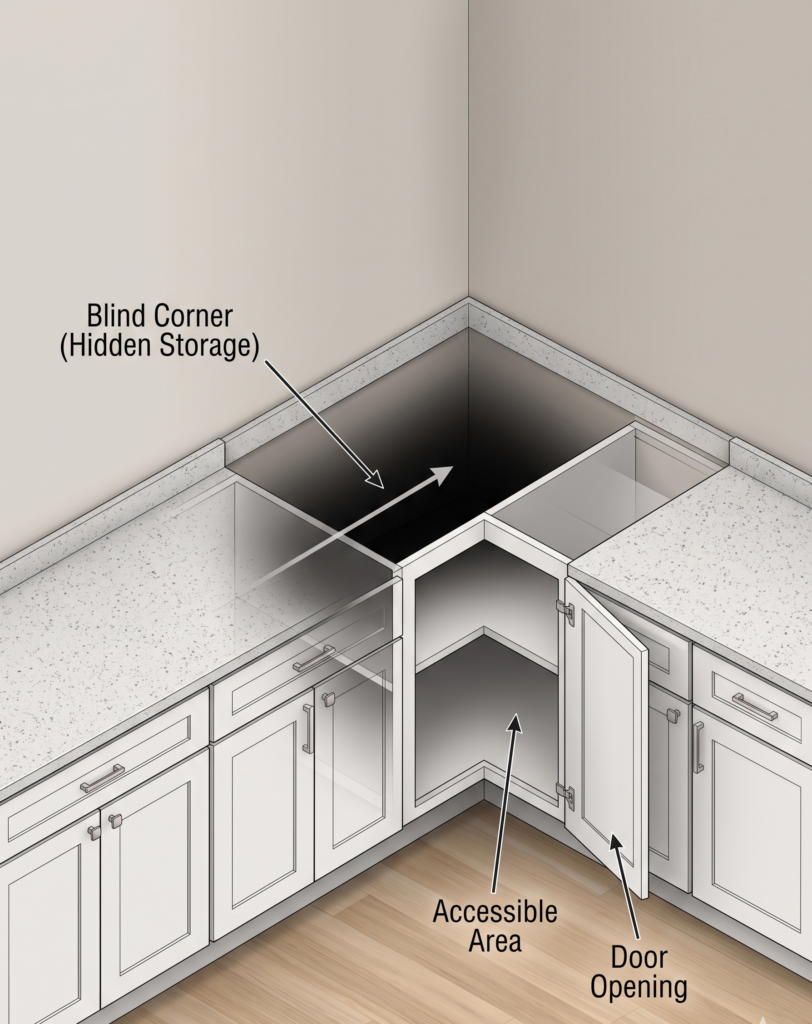
A blind corner cabinet is one where part of the interior is hidden behind the face of the adjoining cabinet, the “blind” section disappears around the corner, out of sight and out of reach. That hidden zone is the storage you’re losing. Any solution is really just a mechanism to bring that hidden section to the front, either by spinning it, swinging it, or sliding it out to you.
Before you shop, note two things about your cabinet: which side the blind part is on (left or right of the door opening) and the width of the door opening. Almost every product is made in left-hand and right-hand versions and sized to specific openings, so getting these wrong is the most common ordering mistake. Measure before you buy anything.
Option 1: The lazy Susan (the classic spinner)
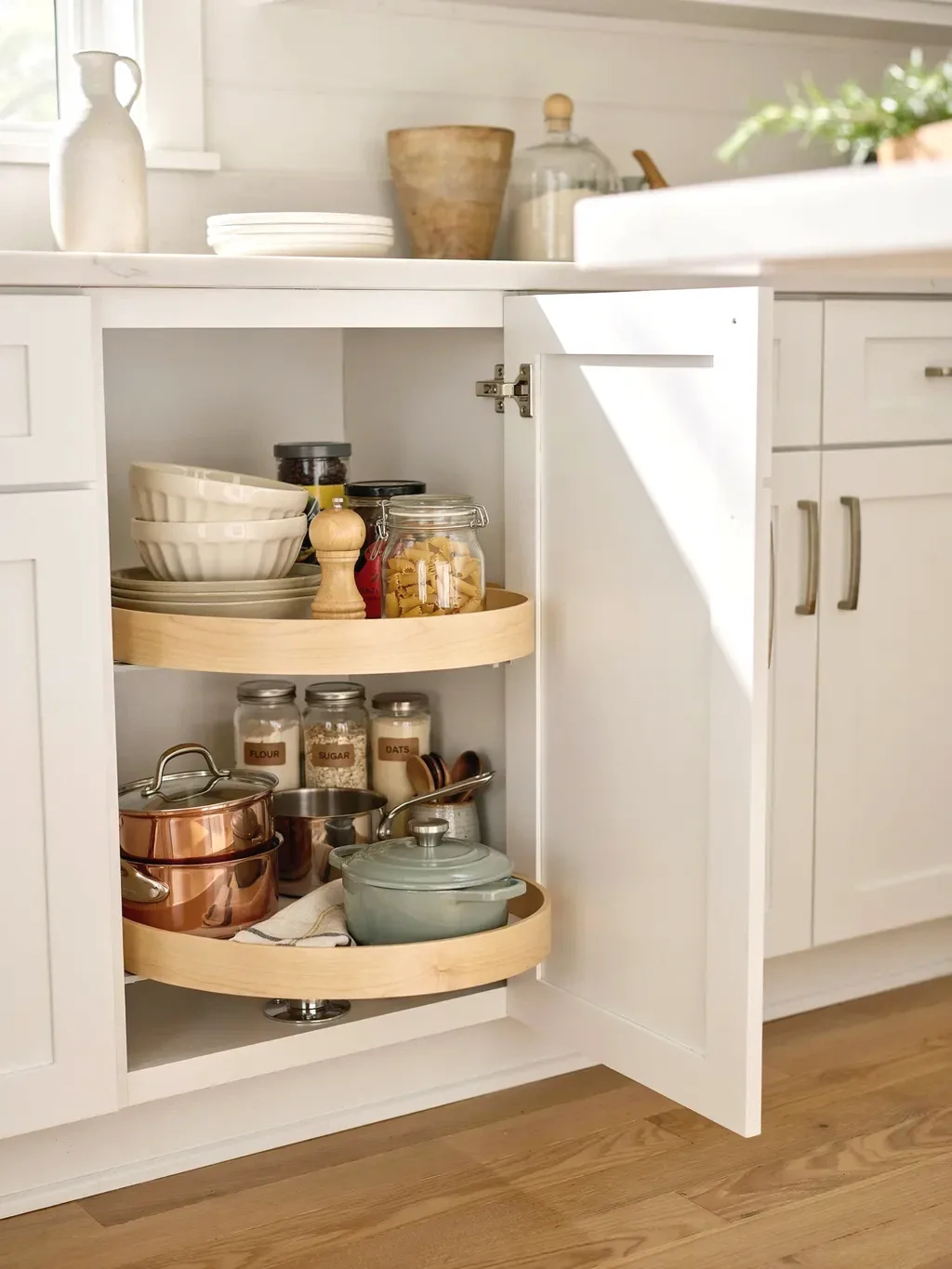
The lazy Susan is the original corner fix: circular or kidney-shaped shelves on a central pole that rotate, so you spin the shelf and whatever you need comes around to the front. It’s been the go-to for decades because it’s simple, effective, and the most cost-effective option out there.
The honest tradeoff: because the shelves are round, you don’t get to use the actual square corners of the cabinet, so a little space goes unused. You also typically need a true corner cabinet (where both doors meet) rather than a blind one for a full round Susan. But for ease of use, nothing beats giving a shelf a spin and having everything roll into reach. They come in floor-mounted, side-mounted, and door-mounted versions depending on your cabinet.
Option 2: The half-moon (the blind-corner specialist)
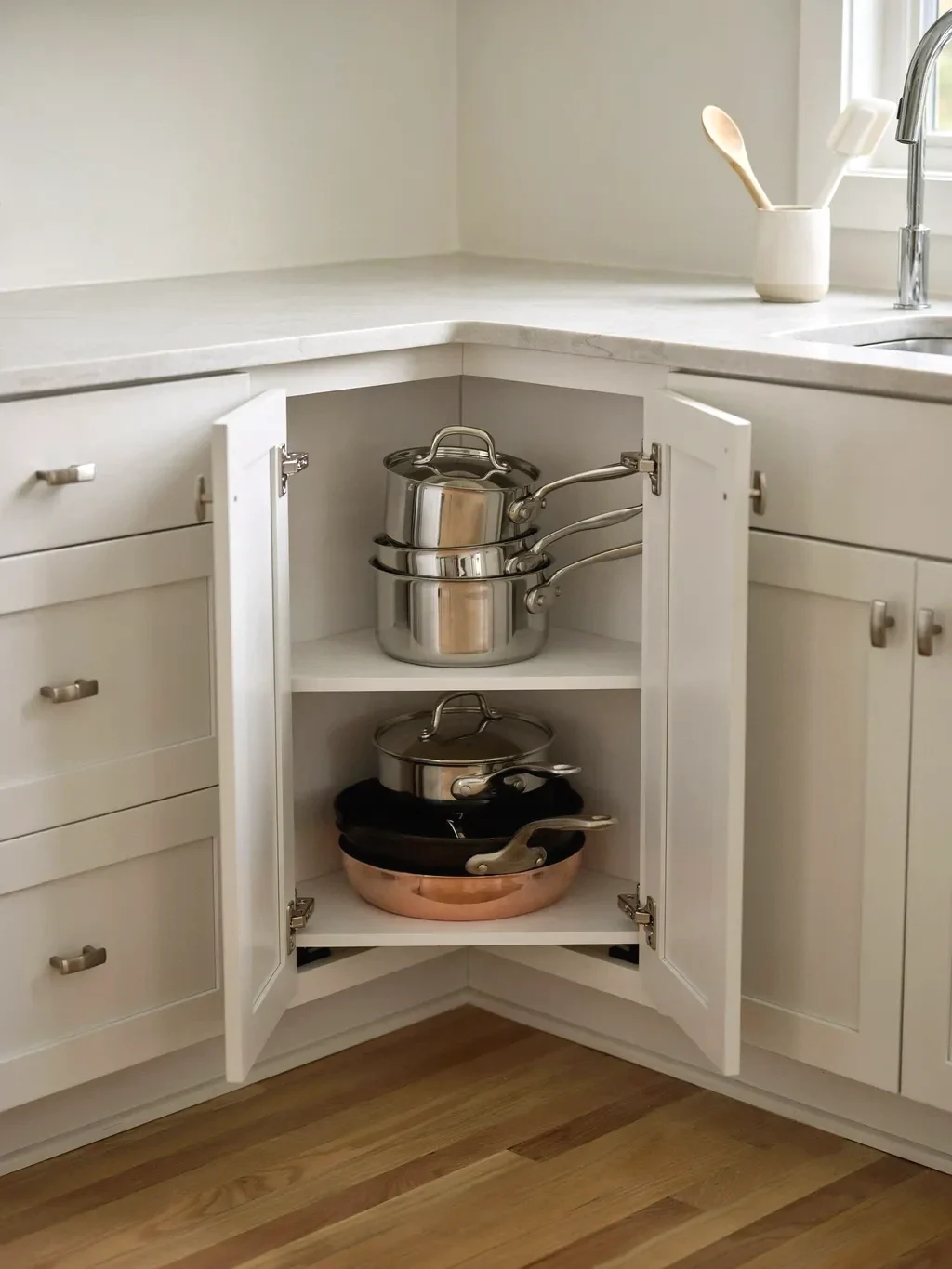
If you have a true blind corner (one door, with the cabinet running off to the side), the half-moon organizer is purpose-built for you. Picture a lazy Susan sliced in half: two D-shaped shelves that pivot toward the door, then slide out, pulling the contents of that hidden back section right out to the opening.
This is the most popular dedicated blind-corner fix because it does the one thing a round Susan can’t, it reaches into the blind section specifically and delivers it to you. It’s a big step up from an empty void, though it still doesn’t capture every cubic inch of the deepest corner. For most people frustrated with a blind cabinet, this is the sweet-spot solution.
Option 3: Swing-out and pull-out optimizers
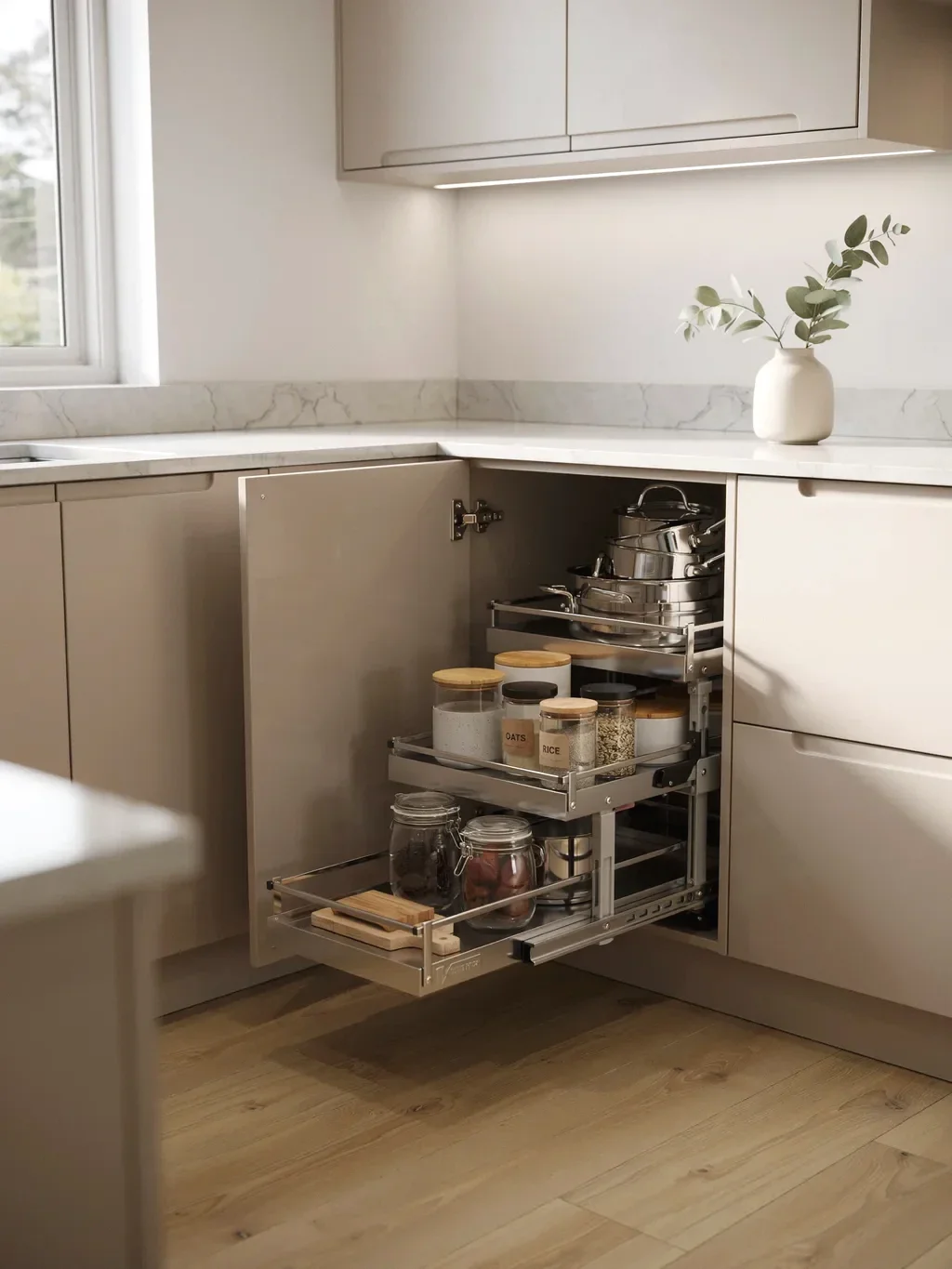
The next tier up in both function and price is the swing-out pull-out system, sold under names like Rev-A-Shelf’s “Girasolo” and similar. These use a soft-close pivot system where the tray glides out of the cabinet and swings toward you in one smooth motion, no need to clear adjacent appliances or counters for it to operate.
These are slick, sturdy, often two-tier, and they pull the deep contents fully clear of the cabinet so you can see everything at once. They’re the more refined, easier-to-use option, and they come in wood, chrome wire, and polymer finishes. The catch is cost and a slightly more involved install, but if this is your everyday cookware cabinet, the daily convenience can be well worth it.
Option 4: The premium fold-out systems (LeMans and kin)
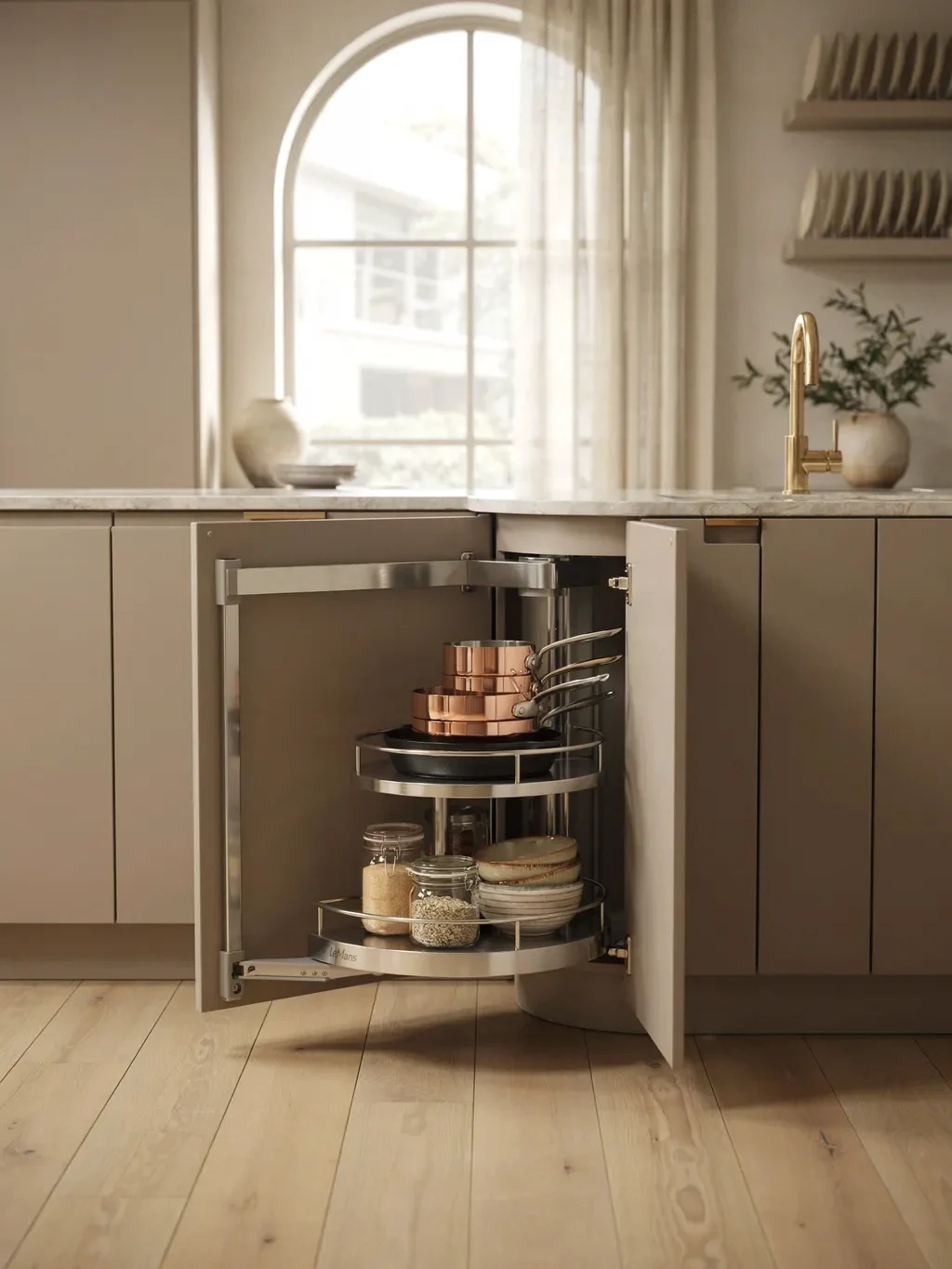
At the top of the range are the European-engineered systems, the Kessebohmer “LeMans” with its distinctive curved kidney-shaped trays, and pull-outs from makers like Vauth-Sagel. These have curved shelves that swing out and follow the contour of the cabinet, delivering the deep contents in a way that feels almost magical.
They’re beautifully made, smooth, soft-closing, and they maximise access better than almost anything else. They’re also the most expensive option and usually the priciest to install. If you’re doing a full renovation or you simply want the best, these are the gold standard. For a budget retrofit, they’re probably more than you need.
How to choose the right one for you
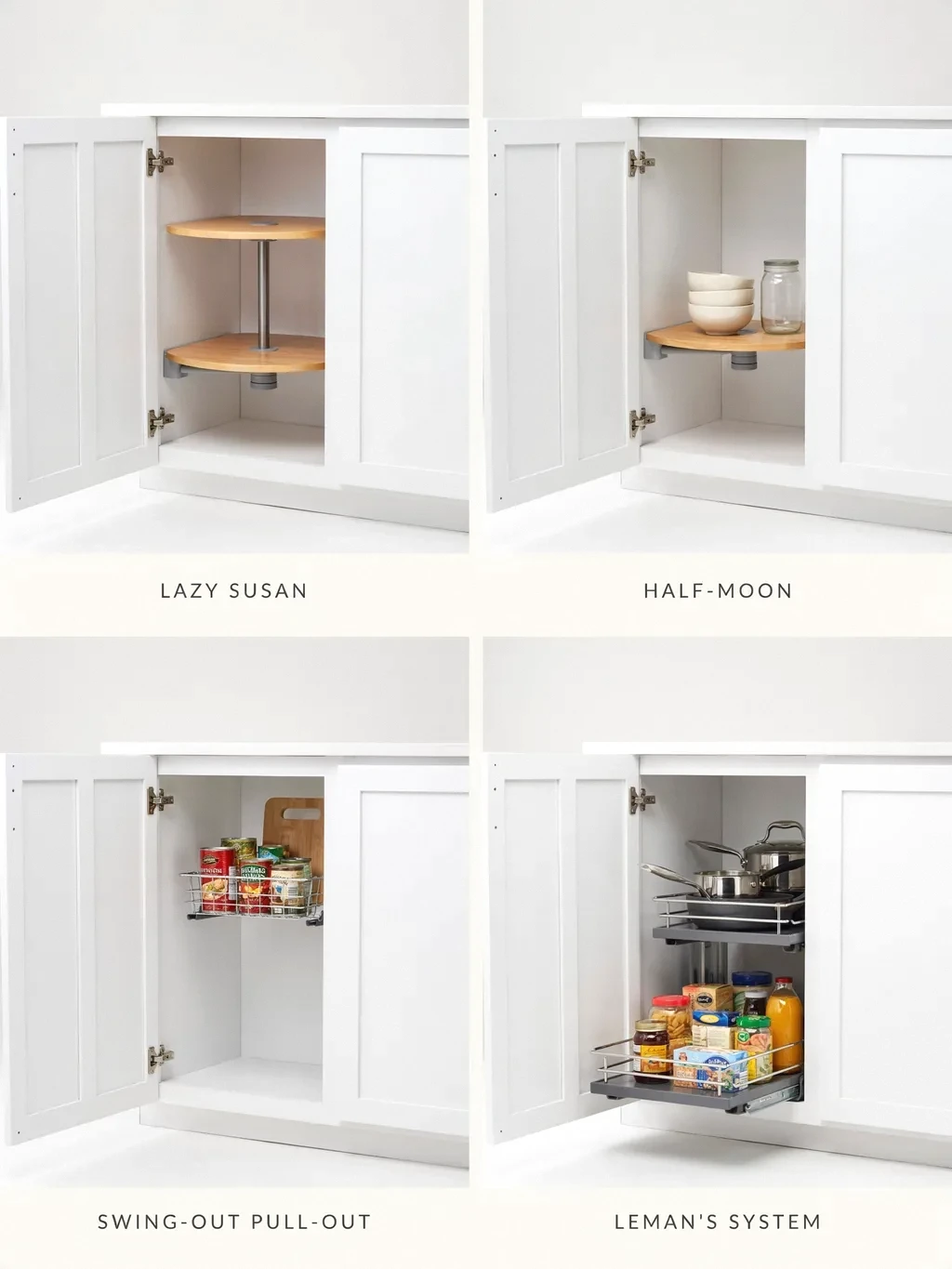
Work through it in this order. First, is it a true corner cabinet (two doors meeting) or a blind corner (one door, hidden side section)? A full lazy Susan suits the former; half-moons and pull-outs are made for the latter. Second, what’s your budget? Lazy Susans and half-moons are the affordable end; swing-out optimizers are mid; LeMans-style systems are premium. Third, how heavy is what you store? Check the weight rating, some budget pull-outs hold around 30 to 35 pounds per basket, which is fine for everyday items but worth confirming if you’re loading cast iron and full stockpots.
And measure, measure, measure: the door opening width, the cabinet depth, and the handedness (left or right blind side). These three numbers determine which products even fit.
A few things to get right on install
Whatever you pick, retrofitting into an existing cabinet is doable for a confident DIYer, but a few details matter. Make sure there’s enough clearance for the mechanism to pivot or slide without catching on the door hinge or the cabinet frame, this is where careful measuring pays off. Many systems mount to the cabinet floor, so check your cabinet base is solid. Use the soft-close versions if they’re offered; they’re worth it for daily use and stop the satisfying-but-eventually-annoying slam.
If drilling and fitting hardware isn’t your thing, this is a very common job for a handyman or cabinet installer, and it’s far cheaper than replacing the cabinet.
A budget workaround if you’re not ready for hardware
Not ready to buy a mechanism? You can claw back some usability for almost nothing. Store only the things you rarely need in the deep blind section (the once-a-year roasting pan, the spare appliance) and keep the front, reachable zone for daily items, so you’re not constantly fishing in the back. A cheap set of stacking bins or a single shallow tray you can slide out by hand also helps corral things into grab-able groups. It’s not as good as a proper pull-out, but it beats the black-hole-of-forgotten-pots situation you have now.
The bottom line
That blind corner isn’t lost storage, it’s just storage waiting for the right mechanism. Figure out whether you’ve got a true corner or a blind one, set your budget, measure your opening and note the handedness, then match it to the fix: a lazy Susan or half-moon for affordable everyday access, a swing-out optimizer for a smoother upgrade, or a LeMans-style system if you want the best. Retrofit it into the cabinet you already own, and the void that’s been swallowing your pots for years finally hands them back. No renovation required, just the right hardware and a tape measure.


